Skip to content


Here's a sentence that surprises almost everyone the first time they read it: some of the most intriguing research on red and near-infrared light is about the eyes. That tends to land strangely, because the same conversation usually includes advice about wearing goggles during a session. So which is it — is red light therapy something your eyes need protection from, or something they might actually benefit from? The honest answer is "a bit of both, for different reasons," and untangling it is genuinely fascinating.
Two Different Questions People Mix Together
The confusion comes from collapsing two separate questions into one. The first is about comfort and glare: should you stare into a bright panel of LEDs from a few inches away for ten minutes? The second is about biology: can specific wavelengths of light do something beneficial for the aging cells of the retina? These have different answers, and keeping them apart is the key to understanding the whole topic.
Let's take the comfort question first, because it's the simpler one and it's where the goggles come in.
Why We Still Recommend Eyewear
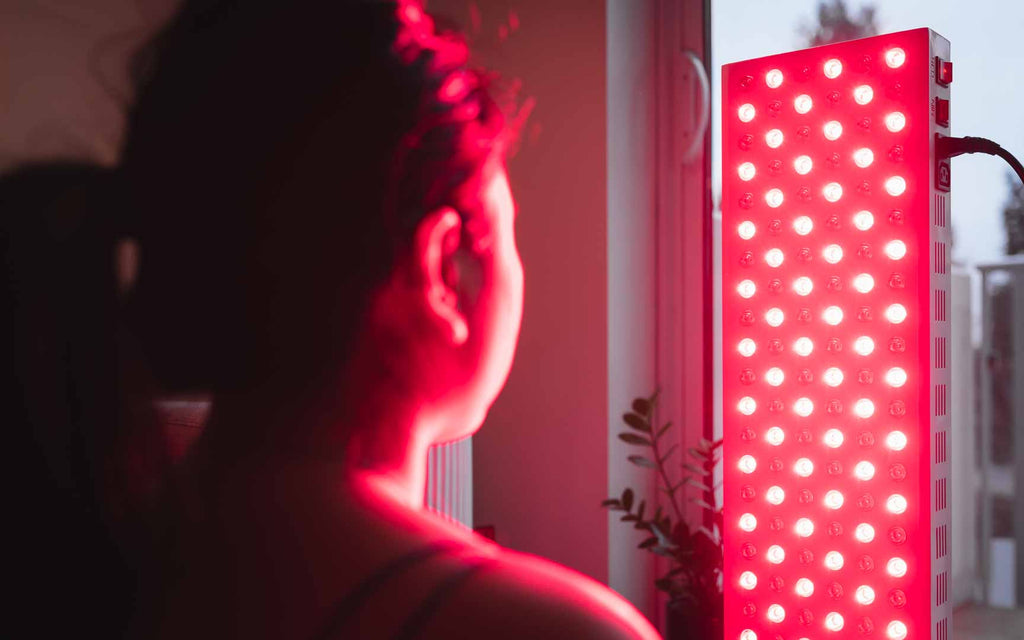
Our standing guidance hasn't changed: we recommend wearing protective eyewear during close facial sessions — not because red or near-infrared light has been shown to harm healthy eyes, but as a standard precaution against prolonged direct exposure to high-intensity LEDs at close range, and to keep sessions comfortable. Bright light of any color is uncomfortable to stare into, and there's no reason to strain your eyes when a simple pair of goggles makes the session pleasant. This is about glare and comfort and sensible caution, not about the wavelengths being dangerous to healthy eyes. Think of it the way you'd think about not staring at a bright bulb — prudent, not alarming.
Now for the far more interesting question.
The Research That Turns the Eye Story on Its Head
The retina is one of the most energy-hungry tissues in the entire body, packed with mitochondria to power the constant work of vision. And like the rest of us, the retina ages — its mitochondria become less efficient over time, which is part of why visual sharpness and color sensitivity tend to decline with age. This is exactly the kind of cellular aging that red and near-infrared light has been studied to support elsewhere in the body, so researchers asked an obvious question: what happens if you apply it to the eye?
The results have been striking. In one study, brief exposure to 670nm light was associated with measurable improvements in color contrast sensitivity in people over roughly 40, the age at which the retina's mitochondrial decline becomes apparent — while having little effect in younger participants whose retinas hadn't yet aged. A separate pilot study explored 670nm photobiomodulation in the context of healthy aging and age-related macular degeneration. The proposed mechanism is the same one that underlies the rest of the field: light absorbed by retinal mitochondria, supporting their energy output and function.
Orion light panels are engineered with clinical-grade wavelengths (660nm red + 850nm near-infrared) at therapeutic irradiance levels proven in peer-reviewed research. Purpose-built for results — not aesthetics.
Shop Orion Light Panels →The Pattern Worth Noticing
There's a detail in the eye research that's easy to skim past but quietly tells the whole story: the benefits showed up specifically in older participants whose retinas had already begun their natural decline, and barely registered in younger people. That age-dependence is a fingerprint of the mechanism. If the light were simply forcing some artificial change, you'd expect it to act on everyone equally. Instead, it appeared to help most where there was age-related mitochondrial slowdown to support — exactly what you'd predict if the light is restoring flagging cellular energy rather than overriding healthy function.
That same pattern echoes across the wider field. Red and near-infrared light tend to show their clearest effects where cells are under stress or aging, helping restore something toward baseline rather than pushing healthy tissue past it. It's a reassuringly biological way for a therapy to behave — supportive and self-limiting rather than forceful. Noticing that pattern is part of what turns a pile of individual studies into a coherent understanding of what this light actually does.
Why This Doesn't Contradict the Goggles
So how can the same light be something we suggest shielding from and something researchers are studying as beneficial for the retina? Because dose and delivery are everything. The vision research uses carefully controlled wavelengths, intensities, and exposure times designed specifically for the eye — a precise, studied protocol. That is a completely different scenario from casually staring into a high-intensity skin panel at close range during a facial session, where the brightness is simply uncomfortable and the device wasn't designed for ocular exposure. Recommending eyewear for your skin sessions and finding the retinal research fascinating aren't in tension at all. One is everyday comfort guidance; the other is controlled science.
What This Means for You Today
Let's be clear and responsible about where things stand. The eye research is early and genuinely exciting, but it is not a green light to point your skin panel at your open eyes, and a general-purpose red light panel is not an approved treatment for any eye condition. If you have an eye health concern — declining vision, macular degeneration, or anything else — that belongs with an ophthalmologist, not a wellness device. What the research does is reframe the bigger picture: it shows that these wavelengths interact with living tissue in supportive, energizing ways rather than harmful ones, which is the same reason they're studied for skin and recovery. For your actual sessions, keep using your panel for your skin and body, wear your eyewear, and let the eye science remain what it currently is — a remarkable and still-unfolding area of study. For the fundamentals of safe, effective use, our complete guide to red light therapy is the place to start.
Why This Whole Story Should Make You More Confident, Not Less
It would be easy to read "researchers are studying light and the retina" and feel newly anxious about your skin sessions. The opposite reaction is the right one. The reason scientists are exploring red and near-infrared light for something as delicate and precious as the aging eye is that these wavelengths have repeatedly shown themselves to interact with living tissue in supportive, energy-restoring ways rather than damaging ones. You don't run careful trials shining a known toxin into people's eyes. The eye research exists precisely because the underlying biology is gentle and biologically plausible.
That should reframe how you think about using a panel on your skin. The same family of wavelengths that researchers are cautiously, hopefully testing on the retina is the family glowing on your face during a routine session. Treat your eyes with sensible comfort precautions, leave any actual eye treatment to professionals and purpose-built protocols, and let the bigger lesson land: this is a technology defined by how cooperatively it works with your cells, not against them.
FAQ
Should I shine my red light panel into my eyes for vision benefits?
No. The eye research uses specialized, controlled protocols and devices — not consumer skin panels. Keep wearing eyewear during facial sessions and leave any eye-health treatment to an ophthalmologist.
Is red light therapy bad for healthy eyes?
Red and near-infrared wavelengths haven't been shown to harm healthy eyes, but staring into any bright light is uncomfortable. Eyewear during close facial sessions is a comfort and caution measure, not a response to a known danger.
A Light Worth Understanding, Not Fearing
The eye chapter of the red light story is the perfect example of why nuance matters. The same technology can warrant a sensible pair of goggles during your skincare routine and, in carefully designed research, show promise for the aging retina — and both things can be true without contradiction. Understand the difference between glare and biology, respect the line between a wellness device and a medical treatment, and you're left with something better than fear or hype: a clear-eyed appreciation for just how interesting this light really is.
This article is for general educational purposes and isn't medical advice. Red light panels are not a treatment for any eye condition; consult an ophthalmologist about eye health concerns.